Body donation in Georgian London
04 Sep 2026
Nicole Salomone
Medical study went through a transformative period during the late Georgian period (circa 1750-1837). During the first half of the eighteenth century, studies in “old anatomy” focused on the soul’s control over the body, where it was located, and how the human body represented the divine creation of God. By the late eighteenth century, this focus transitioned to “new anatomy”, utilising morbid anatomy, wherein medical researchers dissected cadavers to help identify and study the anatomical changes that were caused by various stages of disease. Behind the great Georgian innovators such as William and John Hunter, and Sir Astley Paston Cooper, was a supply chain issue: how to obtain bodies to be used as cadavers.
Scottish anatomist, William Hunter (1718-1783), was a strong advocate for the use of cadavers to enhance anatomical and surgical knowledge. A graduate of the University of Glasgow (1740), his studies focused on anatomy and obstetrics. He began practicing anatomy in London soon after and went on to found the Hunterian School of Anatomy, during the 1760s, which included an anatomy theatre, library, and museum. Hunter used several cadavers for each of his courses so that his students could see how different stages of the same diseases would affect the body’s anatomy. For him, a body that was more than a week old was “of little use” for anatomical observation.1 He also suggested that his students procure cadavers for their own study. Provisional difficulties arose, however, when it came to actually obtaining said cadavers.
Until 1752, only three bodies per year were made legally available for London medical practitioners to use in their anatomical dissections. In 1752, legislation titled, An Act for Better Preventing the Horrid Crime of Murder (1752), colloquially called the Murder Act, passed expanding the number of bodies available from the gallows to include executed murderers. However, London’s Bills of Mortality 1752 to 1832, revealed that only 923 convicts were executed and sentenced to the posthumous punishment of dissection.2 The 11.5 bodies available, annually on average, could not support one medical researcher, let alone enough to support the entirety of London’s thriving medical marketplace.
In order to make up the gap, many medical researchers, including those affiliated with hospitals such as St. Bartholomew’s, St. Thomas’s, or Guy’s Hospitals, utilised the services of resurrectionists. These individuals disinterred recently buried corpses and sold them to medical researchers. The disinterment of a corpse was a misdemeanour crime which came under abandoned property and public indecency legislation. However, if a grave-robber stole grave goods, such as clothing, jewellery, or the winding sheet, it was a felonious offence.
In 2024/2025, the Royal College of Surgeons of England digitised the diary of Joseph Naples, a resurrectionist active in London in 1811-1812. While the diary only covers these years, it is believed that Naples began his resurrectionist career during the early nineteenth century, soon after serving in His Majesty’s Royal Navy. This digitisation is historically significant because the manuscript is too delicate to be viewed independently. While there was an annotated version published in 1896, when Bailey transcribed the diary, he changed the spelling and punctuation to make the flow more uniform. In doing so, he threatened the integrity of the source. This digitisation of the original revitalises its cultural significance and allows scholars to read Naples’s diary as written.
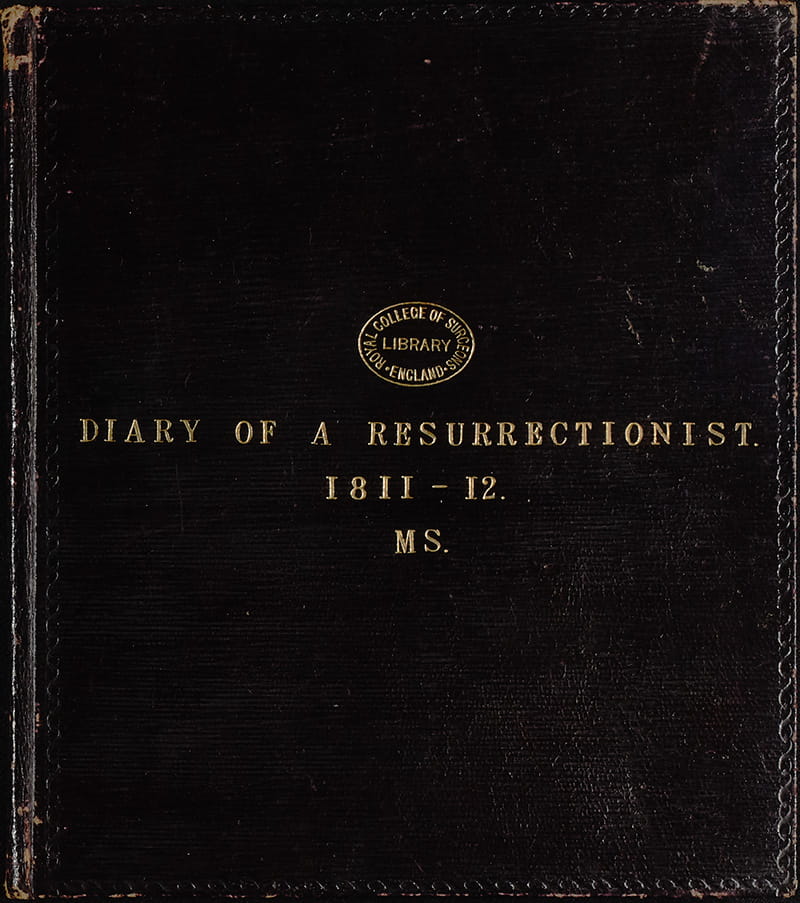
The cover of Joseph Naples’s Diary of a Resurrectionist. RCS England, MS0024/1.
But resurrectionism is not body donation in the truest sense. The Anatomy Act (1832) allowed anyone in “lawful possession” of a dying person to donate their body for anatomical examination postmortem.3 Dying individuals had the right to opt-out of this action if they had expressed in writing that they wished it to not occur. But there was another lesser used option, which until recently was only a supposition: informed, consensual body donation for medical dissections.
The RCS England Archive holds two documents indicating a deeper cultural conversation regarding consensual body donation, both of which were addressed to the London surgeon, Sir Astley Paston Cooper. Cooper was a surgeon and lecturer at Guy’s Hospital and became a member of the Royal College of Surgeons. He was a well-respected London surgeon who networked into medical communities throughout England. He even had a network of resurrectionists at his disposal and advocated for their release when they were arrested.
The first document was from William Williams who, in a letter dated 20 June 1833, detailed his wish to donate his body to Astley Cooper for dissection, provided that he was not married by the time of his death. He requested that “a respectable but a common burial or interment of my dissected remains shall and may be made in such place or burial ground or church yard” as is made accessible.4 Williams’s writing style indicated that he worked with contracts regularly, including nuanced and extended phrasing and disclaimers, as shown above. Williams wrote directly as an informed participant in his body’s donation. He implied that he and Cooper had previously discussed this situation, and he wrote the letter as follow-up documentation. It is not known precisely who Williams was, if this was his real name, or if he was dissected by Astley Cooper.
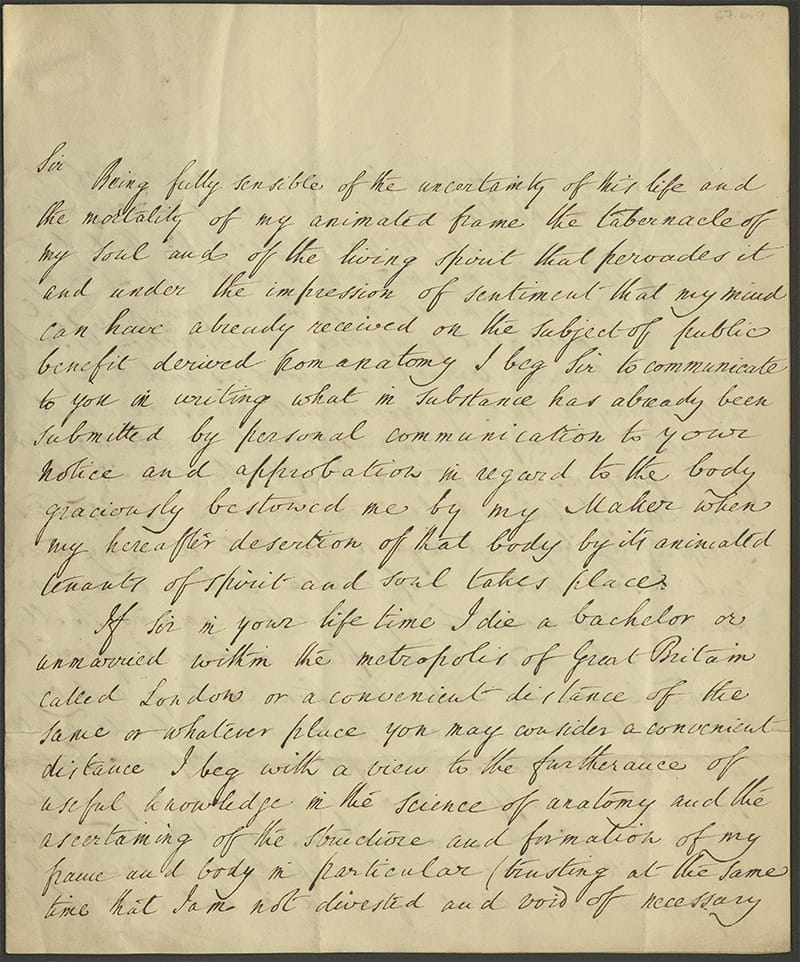
“From William Williams to Sir Astley Cooper, June 20, 1833”, first page. RCS England, MS0008/2/2/1.
The second document is little more than a note that was sent to Astley Cooper on an unknown date and unsigned. This note expressed the knowledge that Astley Cooper was “in the habit of purchasing bodys [sic] and allowing the person a sum weekly ”.5 The author then offered that he knew “a poor woman” who was interested in donating her body.
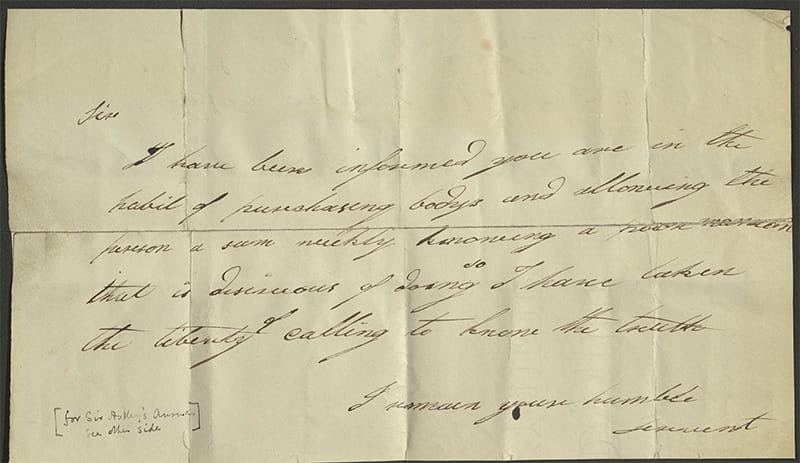
“Offer of recently living body to Astley Cooper, no date”, front. RCS England, MS0008/2/2/1.
Obviously sensing an underhanded deed, Astley’s reply was short and sharp, stating that, “The truth is that you desire to be hanged for such an unfeeling offer.”. Whether Astley believed that author was hoping to secure the weekly payment in exchange for the woman’s body without her consent is not known. What is known is that Williams did not mention a weekly payment in the entirety of his three-page letter consenting for Cooper to use his body for posthumous dissection.
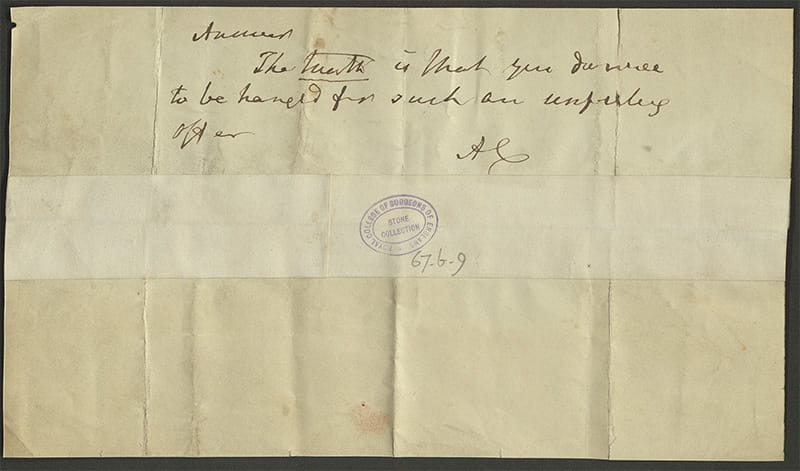
“Offer of recently living body to Astley Cooper, no date”, back. RCS England, MS0008/2/2/1.
These two documents do not provide an all-inclusive explanation of the cultural acceptance of consensual body donation. However, personal interests in body donation to medical professional for posthumous dissection, without any indication that they are going to die soon, is a new cultural conversation to be further analysed.
These new documents suggest that obtaining bodies for use as cadavers was a more robust cultural conversation than has been previously understood. While the bulk of cadavers for use in medical study came from resurrectionists, the only known legal option to obtain cadavers, between 1752 and 1832, were from the gallows. These documents are indicative of a third option: willingly consenting the donation of one’s body to the medical community for study.
Nicole Salomone, PhD.
References
- Hunter W. Two Introductory Lectures, Delivered by Dr. William Hunter, to His Last Course of Anatomical Lectures, at his Theatre in Windmill -Street. London; 1784. p88.
- Hurren E. “Other Spaces” for the Dangerous Dead of Provincial England, c. 1752-1832. In: Journal of the Historical Association 2018; 103(354): 27-59. p29.
- Baron CFJ. Law and the Corpse. In: British Medical Journal 1966; 2(5513): 1074-1075. p1074.
- Williams W. “From William Wiliams to Sir Astley Cooper, June 20, 1833.” 1833. Located at: Royal College of Surgeons of England Archive, London; MS0008/2/2/1.
- “Offer of recently living body to Astley Cooper, no date.” Located at: Royal College of Surgeons of England Archive, London; MS0008/2/2/1.
Further reading
- Baron CFJ. Law and the Corpse. In: British Medical Journal 1966; 2(5513): 1074-1075.
- Burch D. Astley Paston Cooper (1768-1841): Anatomist, Radical and Surgeon. In: Journal of the Royal Society of Medicine 2010; 103(12): 505-508. DOI: 10.1258/jrsm.2010.10k039.
- Cunningham A. The Anatomist Anatomis’d: An Experimental Discipline in Enlightenment Europe. London: Routledge; 2010.
- Guerrini A. The Value of a Dead Body. In: Deutsch J, Terrall M, ed. Vital Matters: Eighteenth-Century Views of Conception, Life, and Death. Toronto: University of Toronto Press; 2012.
- Hogan C. Diary of a Resurrectionist: The Unique Record of a Frightening Trade Born Out of Necessity. 27 May 2025. In: Royal College of Surgeons of England. Library Blog [online]. https://www.rcseng.ac.uk/library-and-publications/library/blog/diary-of-a-resurrectionist (cited 4 September 2026).
- Houlbrooke R. The Age of Decency: 1660-1760. In: Jupp PC, Gittings C, ed. Death in England: An Illustrated History. Manchester: Manchester University Press; 2018.
- Hunter W. Two Introductory Lectures, Delivered by Dr. William Hunter, to His Last Course of Anatomical Lectures, at his Theatre in Windmill -Street. London; 1784.
- Hurren E. “Other Spaces” for the Dangerous Dead of Provincial England, c. 1752-1832. In: Journal of the Historical Association 2018; 103(354): 27-59.
- Jervons FR, Schneck JM, Agnew LRC et al. Notes and Events. In: Journal of the History of Medicine and Allied Sciences 1963; 18(2): 174-181.
- Lennox S. Bodysnatchers: Digging Up the Untold Stories of Britain’s Resurrection Men. Barnsley: Pen & Sword Books; 2016.
- Munk W. William Hunter. In: Royal College of Physicians. Inspiring Physicians [online]. https://history.rcp.ac.uk/inspiring-physicians/william-hunter (cited 4 September 2026).