Natural magic and medicine in the library collection
17 Apr 2026
Georgia Wallace
Content notice: The following article includes references to historical medical treatments involving human tissue. We share this material to support informed engagement with our library collections and to highlight the diverse experiences of people throughout medical history, as well as the development of therapeutic practices.
Today, magic and science are two somewhat distinct fields; one is a broad term that includes mysticism, the supernatural and modern-day illusions, while the other is defined by evidence-based research. This distinction, however, is relatively recent in world history and Eurocentric in scope. In many cultures today, magic, science, and religion remain closely connected, as was the case in early modern Britain. Alongside the great scientific innovators of the late Renaissance and Enlightenment periods were a group of theorists who followed the principles of “natural magic” (magia naturalis), largely derived from the works of the German physician and alchemist Paracelsus (1493-1541).
In the sixteenth century, Paracelsus openly challenged the authority of Avicenna and Galen, arguing that scientific knowledge was not complete but still unfolding, as God’s messages and mysteries had yet to be fully revealed and remained humanity’s responsibility to uncover. To command the forces of nature and reveal God’s teachings was, for Paracelsus, an act of magic; thus, the Magus was a wise man whom nature (a personification of God’s teachings) had taught her secrets. The term “natural magic” therefore refers to the manipulation of nature’s hidden forces and secrets through scientific experimentation, with the aim of producing practical results that benefit mankind.
Mentions and examples of natural magic are present throughout the library collection, whether in texts by Paracelsus himself, or in works by his followers in the seventeenth century; notably Jan Baptist van Helmont, Oswold Croll, Robert Fludd, and Nicholas Culpepper. Before exploring these examples, however, some theoretical context is required.
Natural magic functioned within the antiquarian worldview of the microcosm-macrocosm.
Humans are a “little world” in themselves – the microcosm – which consists of the mind, body, soul, and four humours. The microcosm was directly influenced by the macrocosm, which is composed of spheres stacked like nesting dolls that surround the human, that are constantly in motion: one for the moon, one for each planet, one for all the stars, and, lastly, the Empyrean, where God and the blessed souls reside. The positions of these rotating spheres at the time of one's birth determine their astrological “birth chart”, which predisposes their physical and mental temperament; however, as the spheres move, so does their effect on both an individual's body and the environmental events on earth.
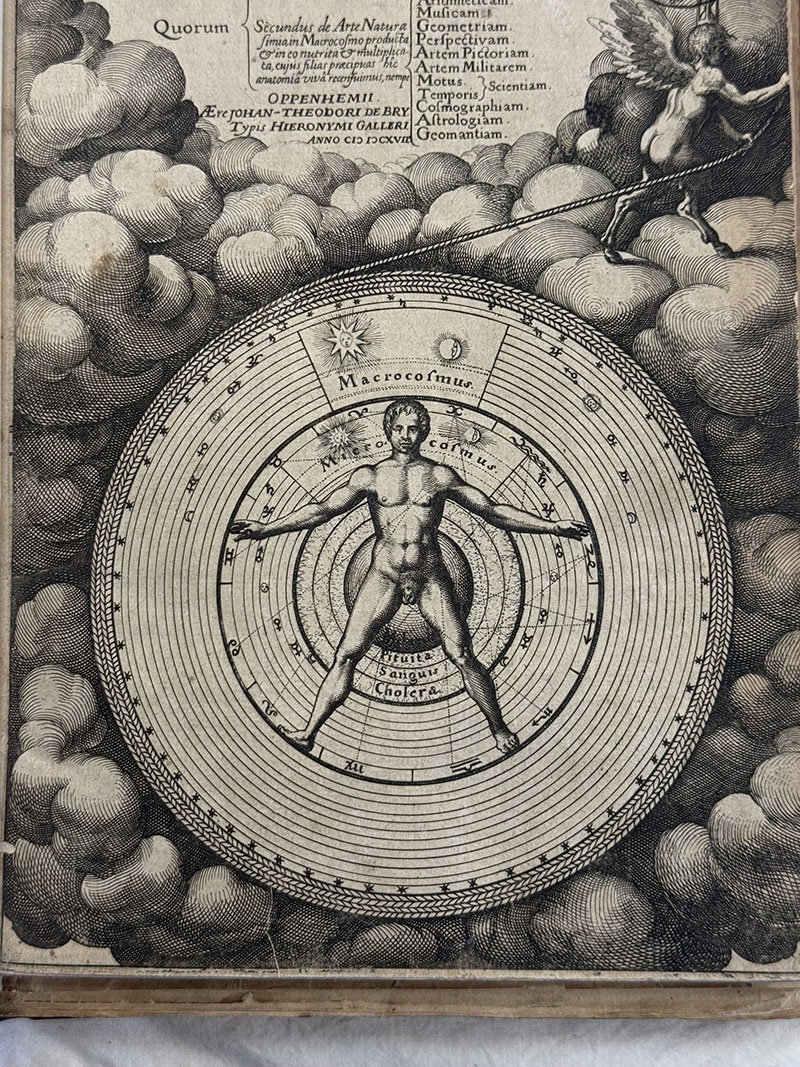
Illustration of the microcosm-macrocosm including the humours, zodiac signs, and planetary positions, from Robert Fludd’s Utriusque cosmi maioris scilicet et minoris metaphysica, 1621.
Natural magic was, therefore, a type of bridge between the microcosm and macrocosm that connected humans and the universe; if one could understand and harness the celestial powers above, they could mirror such knowledge onto the human body in order to heal it. This theory is complicated and somewhat alien to our modern minds, but can be better understood through examples as written by the aforementioned medical men, notably the “doctrine of signatures” and the “weapon salve”.
The doctrine of signatures was a popular healing theory from the fifteenth to seventeenth century, however its belief was rooted in ancient theory, as noted by Pliny the Elder (fl. 79 AD). The logic behind it was that “like cured like”; God had created plants, animals, and minerals with “signatures” in their physical appearance that indicated their curative properties and medicinal uses. The signature could be in the specimen’s shape (e.g. the wrinkled texture of a walnut mirrored the appearance of the brain, therefore it was used for treating maladies of the head), or its colour (e.g. plants with yellow sap or yellow flowers were signalled that they could be used to treat jaundice, a condition marked by the yellowing of the skin.)
Oswold Croll (1560-1609), a professor of medicine at the University of Marburg, discusses different examples of the doctrine of signatures in Bazilica chymica (1670), however gives particular attention to plague treatment made popular by Paracelsus, known as the “Zenexton”, or “toad amulet”.
Since its first outbreak in the fourteenth century, a cure for the bubonic plague had yet to be discovered. A later outbreak in 1665-66 likely prompted Croll to reevaluate any possible treatments for the plague, and to revive the Zenexton. Those who believed in natural magic and the doctrine of signatures understood the bumpy, “buboed” skin of a toad to be an indication that the animal could treat, or cure, the bubonic plague; the toad would “sympathise” with the human buboes and draw the infection out of the body, into its own bumpy skin (though the act would’ve been invisible to the human eye). If a patient was of lesser means, they could simply attach a dried toad to the buboed area. If you could afford it, however, a much more effective remedy would be to mix the toad with other plague-fighting ingredients into a Zenexton.
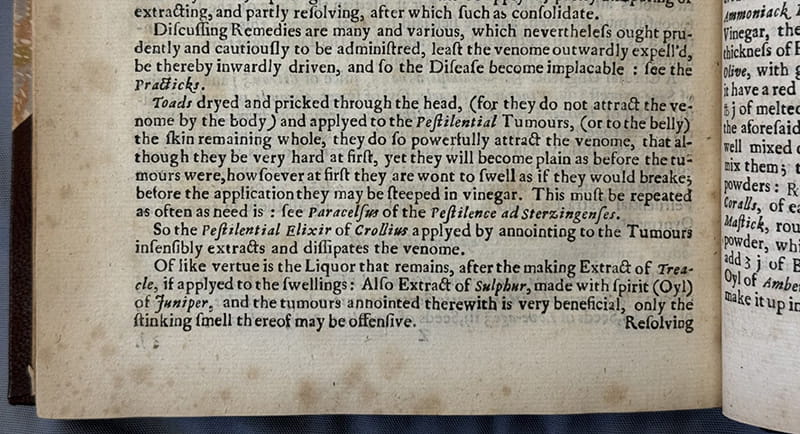
Croll discussing how when dried toads attract pestilential venom, they “swell as if they would breake”. Bazilica chymica, 1670.
Croll recites the elaborate instructions Paracelsus gave for making the toad amulet, as follows: 18 pulverised toads, prepared under the proper phase of the moon, should be mixed with white arsenic, dittany roots, pearls, coral, emeralds, and linen rags “moistened in the menstruum of a Virgin”, then shaped into small cakes and placed in a small metal case. When hung from the neck and worn near the heart, the sympathetic powers of the microcosm-macrocosm embedded in the Zenexton would draw out the disease and protect the wearer against future plague.
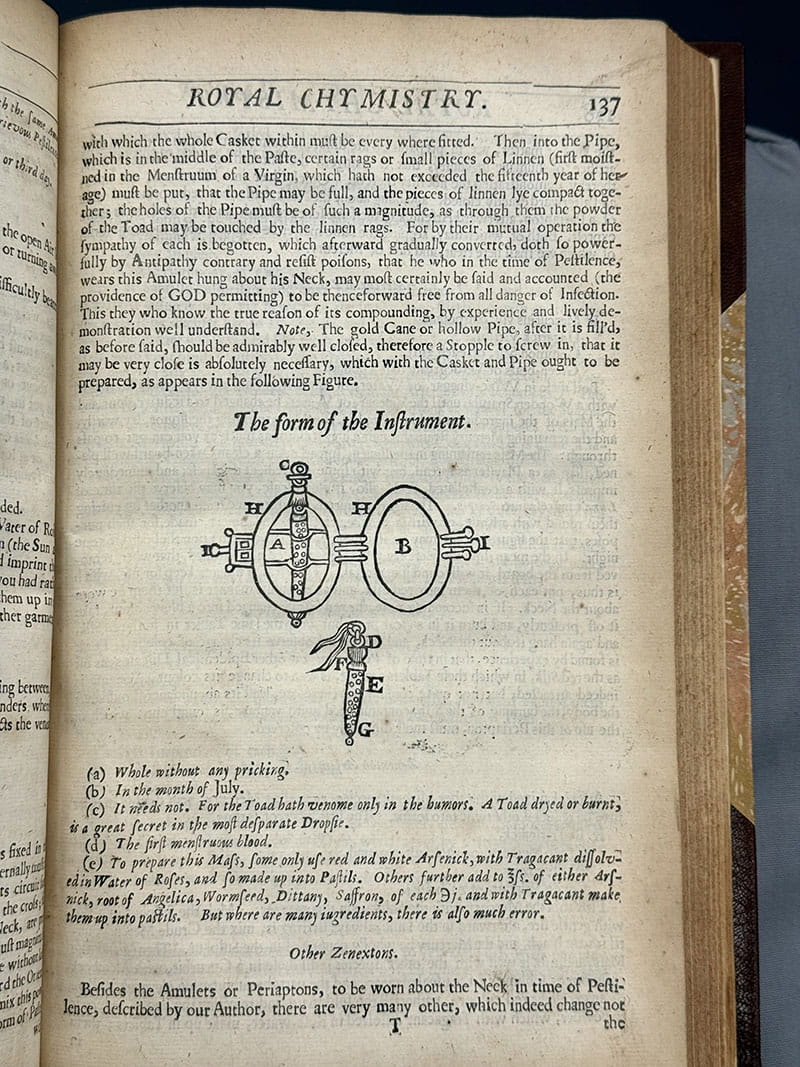
Directions for how to prepare the ingredients for, and make the “Zenexton of Paracelsus”. Croll writes the amulet “will hath a Magnetick attractive virtue, it attracts to it self the Pestilential venome”. Bazilica chymica,1670.
The “weapon salve” worked in a similar way in that it harnessed the natural magical powers between the microcosm and macrocosm, however it was more complex in theory, and much gorier. The belief was that a wound could be healed by treating the weapon that caused it with an powerful curative ointment: for example, Robert Fludd writes that he knew of a servant who was in great pain after he cut himself with an axe, however once Fludd dressed the bloody axe with the salve, the servant began to feel completely well (The Squesing of Parson Fasters Sponge, 1631).
The directions for making the weapon salve derive from post-Paracelsian thinkers, such as Jan Baptist van Helmont (1580-1644) and Rudolph Goclenius (1572-1621), and include very specific, human ingredients: powdered mummy (preserved human flesh), human fat, and usena.
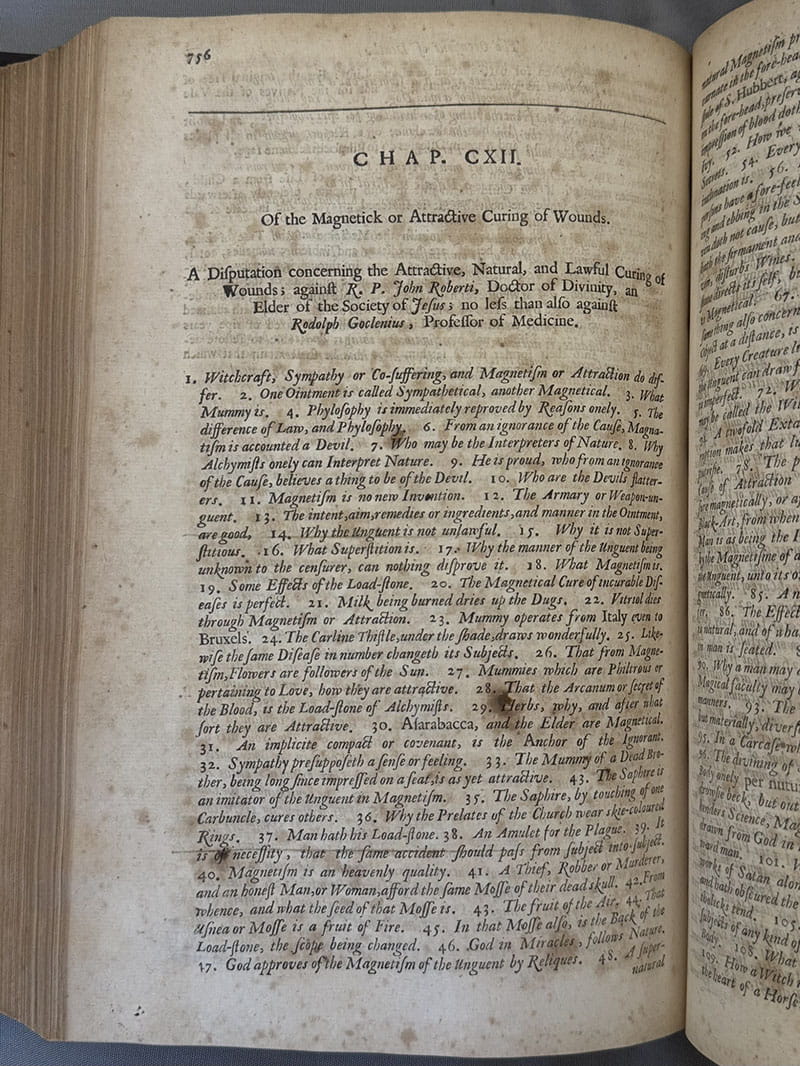
“Of the Magnetik or Attractive Curing of Wounds”, a chapter which includes the instructions for making the weapon salve and positive examples of its use. Jan Baptise van Helmont, Oriatrike, 1662.
Usnea, also known as “old man’s beard” or “skull lichen”, was the name given to moss that grows on the skulls of deceased humans, particularly of executed criminals. Apothecaries charged a high price for the moss, not only because of its rarity, but because of its magical powers. Belief in the efficacy of usnea relied on the idea that the vital spirit of human life was stored in the bones after death, and that the moss grew from the interaction of this trapped spirit with macrocosmic, celestial forces.
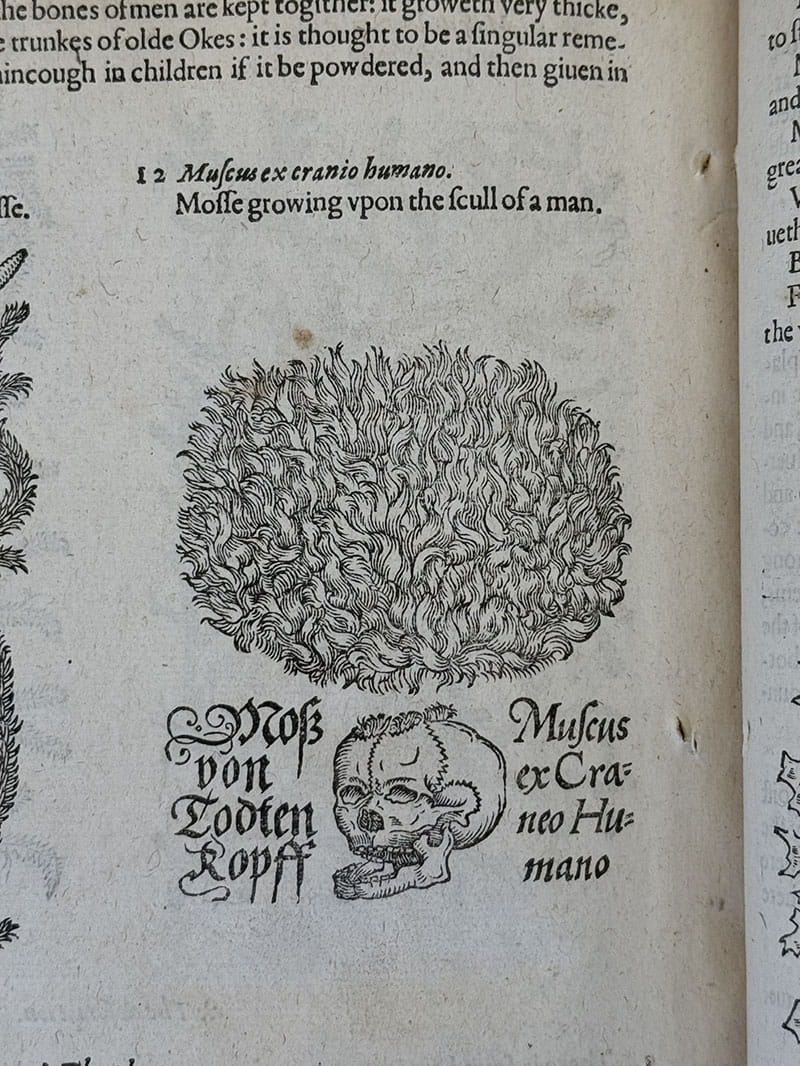
Usnea (“skull lichen”) from John Gerrad, The herball, or, Generall historie of plantes, 1597.
Only by using such powerful ingredients derived from humans would the weapon salve work, as like could only cure like. When the ingredients of the salve were placed on the weapon (which was covered in the blood of the injured), it would attract cosmic powers that would carry the ingredients’ healing energies from the salve to the wound – even if the weapon and the injured person were miles apart.
Although these medical remedies sound macabre, bizarre or gruesome today, it is important to remember that they were grounded in complex theologies and astrological knowledge and were not simply “quackery”. Natural magical medicine instead reflects the intrinsic desire for humans to understand their bodies and protect their health – something that has remained pertinent throughout history.
Georgia Wallace, Information Assistant
You can read more about other botanical and medical texts from the medieval period, in our new digital exhibition, “Rootless Phantom”.