Women in the shadows – the role of women in the trade of body snatching and burking
21 Oct 2026
Corinne Hogan
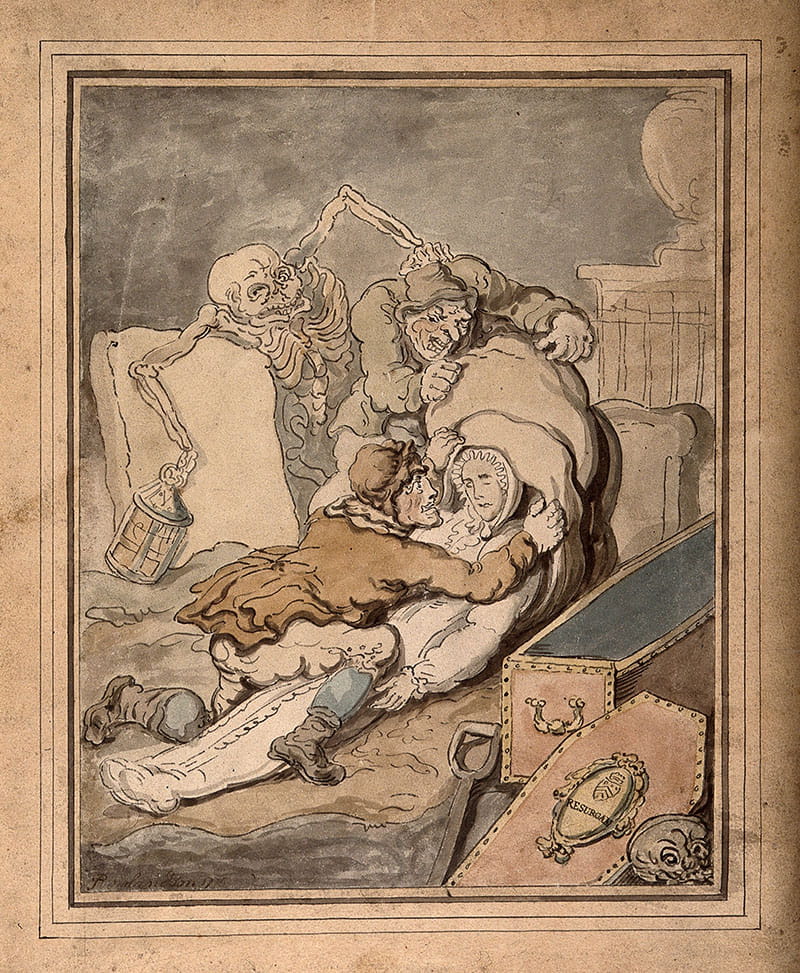
Thomas Rowlandson. Grave robbers with death pictured as a nightwatchman, 1755.
A previous blog post showcased the digitised Diary of a Resurrectionist, explaining the context of snatching bodies for anatomical dissection in the late 18th and early 19th centuries. This article examines the role of women in the phenomenon by reassessing the trade through an examination of contemporary accounts, real and fictional representations and secondary historical materials, taking into account inherent biases and the specific audiences for which the primary sources were created and looking at where and to what extent women were involved both as participants and victims.
James Blake Bailey, a former Librarian at the College, contributed a historical sketch of the period (published in 1896) about the macabre trade and offered several interesting insights. Notably, women appear not at the centre of the resurrection trade, but at its edges, where access, trust, and vulnerability shaped the illicit movement of bodies from graves. So what exact roles did women play in body snatching? As the following evidence shows, women were on both the criminal and victim sides of the action.
Female body snatchers before Burke and Hare
The best-known women associated with the crime of burking (murdering to supply to anatomists) are Margaret Hare and Helen McDougal (the wives of Burke and Hare), but female involvement can be traced much earlier.
There was a case of two Edinburgh women, Helen Torrence and Jean Waldie, tried in 1752 for murdering a young boy. A contemporary record notes “Helen Torrance and Jean Waldie were executed this day, for stealing a child, eight or nine years of age, and selling its body to the surgeons for dissection. Alive on Tuesday, when carried off, and dead on Friday, with an incision in the belly, but sewn up again.” (From Tolbooth’s log for March 18, 1751/2.)
George MacGregor in his 1884 book The History of Burke and Hare, describes the pair as nurses who had promised medical students that they would find them a corpse. Their original scheme was to obtain one through their access to the recently dead:
They would appear to have been nurses, and they promised to some doctors’ apprentices that they would supply them with a subject, proposing to do so by the abstraction of a body from a coffin, when they were sitting at the death-watch.
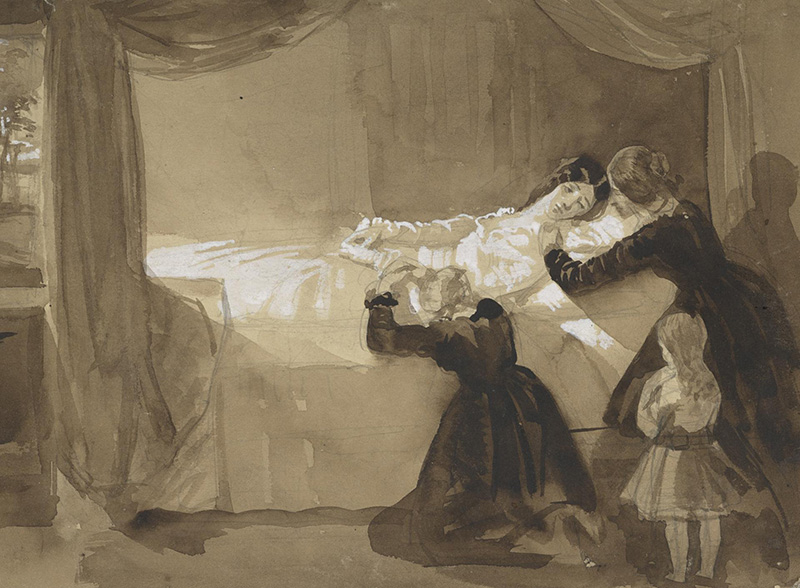
Unknown Artist. A deathbed scene. William Finlay Watson Bequest 1881, National Galleries of Scotland.
When that plan failed, they murdered the boy and took his body to the surgeons. The episode highlights the fact that women's work around sickness, death and the domestic care of bodies could potentially give them forms of access to the deceased that were very different from those of the stereotypical male body snatcher.
Women and children as anatomical commodities
Women and children were also among the bodies that were snatched from graveyards or murdered to meet the demand from anatomists. In Scotland, MacGregor describes medical students learning of a burial at Rosyth, going to dig it up and transporting it towards Edinburgh. Disturbingly, they gave the dead woman a nickname, referring to her as the “tall beauty”. The whole scene is told in unsparingly gruseome terms by MacGregor here:
They heard of the burial of a woman who had died in child-bed, and they rowed over the Firth to raise her body. When they got to the grave-yard the weather was wild and stormy…After twenty minutes’ work the students had ‘the tall beauty,’ as they had named her, again above the ground, and carried her to the dyke, upon which they laid her until they had climbed over themselves…They made for their boat, taking care, however, to carry the corpse with them. The dead woman’s long golden hair had become entangled among the stones, and the rough manner in which they dragged the body away left some of the locks, with a portion of the scalp, on the side of the dyke. They immediately put off, and afterwards saw the lantern stop at the point of the dyke where the body had lain. It was currently reported that the bearer of the lantern was the woman’s husband, and that he recognised the hair entangled on the wall.
The traffic in bodies could even cross national boundaries. Evidence collected from a Belfast newspaper records corpses being transported from Ireland to Scotland. The account describes a barrel discovered at Belfast docks in July 1823 containing the body of a woman of about thirty and that of a child aged approximately three, both recently buried at Friar's Bush graveyard. They had been “packed in sawdust” for transportation.
This account confirms again that the trade wasn’t just bodysnatching in the traditional graveyard setting: MacGregor also records an 1828 Glasgow incident in which a medical attendant was seen leaving the home of a poor woman carrying her stillborn infant. The explanation subsequently given was that the mother had permitted the student to take the child's body in return for attending her confinement. Understanding the trade solely through the activities of body snatchers risks missing a wider social economy through which the dead became anatomical “subjects”.
Women as victims of opportunism
Women were also recorded as victims of body snatchers in some more opportunistic crimes, one example involved a woman who committed suicide by drowning at the Surrey Canal in Camberwell in 1823. After her body was recovered from the river, it was stored in an outbuilding with the agreement of the landlord of a local inn until authorities could investigate and send it for a Coroner’s inquest. In the interval between closing the door on the body and when they came to attend to it the next day, it had been stolen. Bailey reports that the landlord:
instantly repaired to the Police Office, Union Street, and gave information of the circumstance to the Magistrates, who gave orders that immediate enquiry should be made at Mr Brooke’s, where the body has since been discovered and given up. The poor woman was unclaimed, and the verdict of the Coroner’s Jury was ‘Found Drowned’.
Women as accomplices
During the 1828 Anatomy Act enquiry into the supply of bodies for anatomisation, the evidence included instances of women “decently clad in mourning” claiming bodies as if they were related to the deceased. In these cases, they acted as facilitators, lending the con familial respectability. Arriving with the means to transport the body and acting distressed, they tricked hospital staff into believing they had a decent, legitimate reason to take a body away for burial. Some accounts refer to the body being immediately taken to the anatomist, straight from this “false-claiming”.
This means of obtaining bodies would have relied upon an inside source of knowledge in the workhouse or similar institutions - reporting to the gang that a person had died and had no family coming forward to bury them and that they could, therefore, be claimed before they were given a charity burial. Bailey suggests that:
The parish authorities, probably, were not over particular about giving up the body, if the deceased were a stranger, as by this means they saved the cost of the burial.
(Ironically, it was precisely this unclaimed category of the deceased that would later be made available to surgeons legally via the provisions of the Anatomy Act.)
The women in the Burke and Hare case
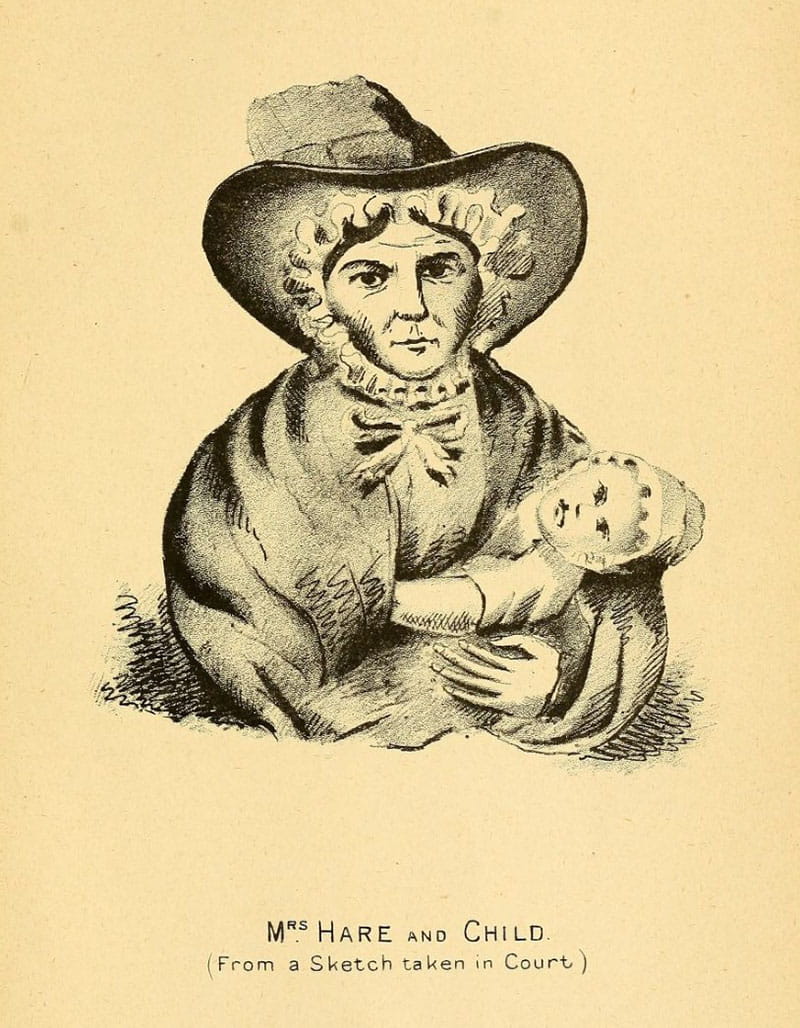
From: George MacGregor. The History of Burke and Hare and of the Resurrectionist Times. Glasgow: T. D. Morison, 1884. Public Domain.
The Edinburgh murders of 1828 provide more substantial evidence of women participating in the procurement of bodies. Indeed, describing Margaret Hare merely as an “accomplice” may understate her role. MacGregor describes one occasion on which Hare encountered an elderly woman and “persuaded [her] to go with her to her house”. There she repeatedly supplied the woman with alcohol until she was incapable of protecting herself, after which William Hare killed her.
Even more revealing was Hare's testimony. Asked what she believed had happened to a woman who had disappeared from the house, she replied:
I had a supposition that she had been murdered. I have seen such tricks before.
Helen McDougal also appears as more than just a passive observer. After Mary Docherty's body was discovered, MacGregor records McDougal attempting to persuade suspicious lodgers not to report their discovery, at one point suggesting:
there never would be a week after that but what he might be worth ten pounds.
In other words, McDougal was apparently offering the lodger ten pounds a week to remain silent. The familiar label “Burke and Hare” can therefore obscure the extent to which their activities operated through households in which women also participated.
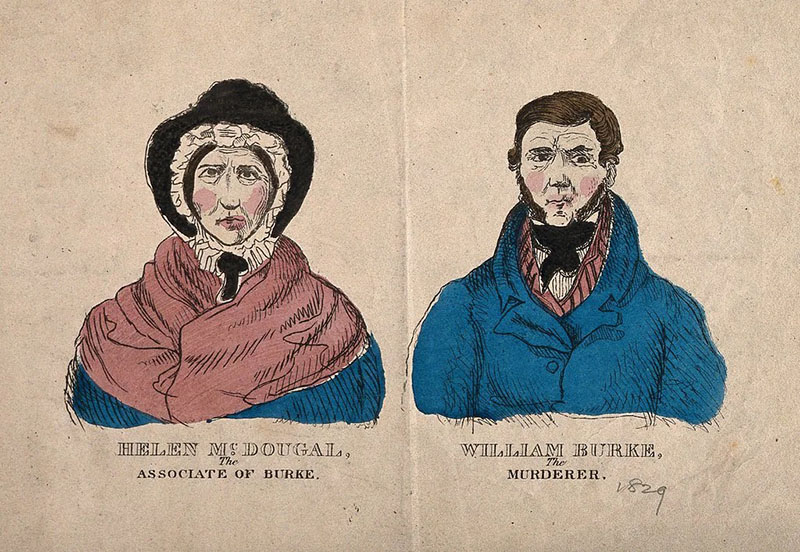
From: George MacGregor. The History of Burke and Hare and of the Resurrectionist Times. Glasgow: T. D. Morison, 1884. Public Domain.
A woman convicted of “Burking”
Nor was this exclusively an Edinburgh phenomenon. In England, Eliza Ross, also known as Cook, was executed in 1832 for the murder of 84-year-old Catherine Walsh. The title of a surviving contemporary broadside leaves little ambiguity about the perceived motive: “The full account of the execution of Eliza Ross alias Cook, on Monday, Jan. 9, 1832, for burking Catherine Walsh, an old woman, aged 84, and disposing of her body to the surgeons”.
The Newgate Calendar similarly placed Elizabeth Ross among its body-snatching cases, describing her as “Executed for a ‘Burking’ Murder”. The case is significant because Ross was not simply the female companion of a male resurrectionist. In the contemporary printed record, she herself was identified as someone who killed to supply a body to the anatomical market.
In popular culture
Evidence within fictional accounts shows the preoccupation of society with the horror of discovering that someone from your family had been taken from their grave. In one story, a sailor comes back from a voyage and decides to give up his life on the seas. Finding no other opportunities, he is persuaded to join a body snatching gang. During the commission of an attempt to snatch a body, the man makes the tragic discovery that the gang has targeted the body of his sweetheart (Bailey). In another story a deceased fiancée, having been buried and then snatched is tracked down by her fiancé, who can only claim the body by paying for it (Dixon).
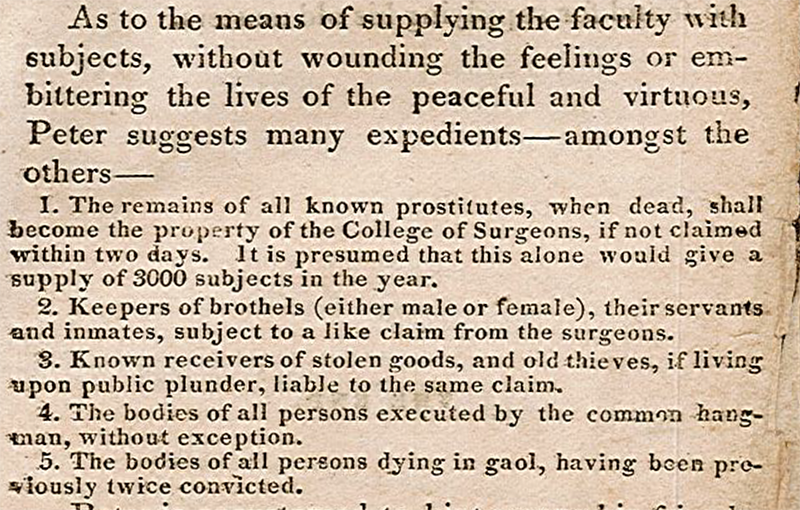
Peter Dixon’s suggestions for how to supply bodies to the anatomists from The Life and Confessions of Peter Dixon the Celebrated Body Snatcher. [c.1827].
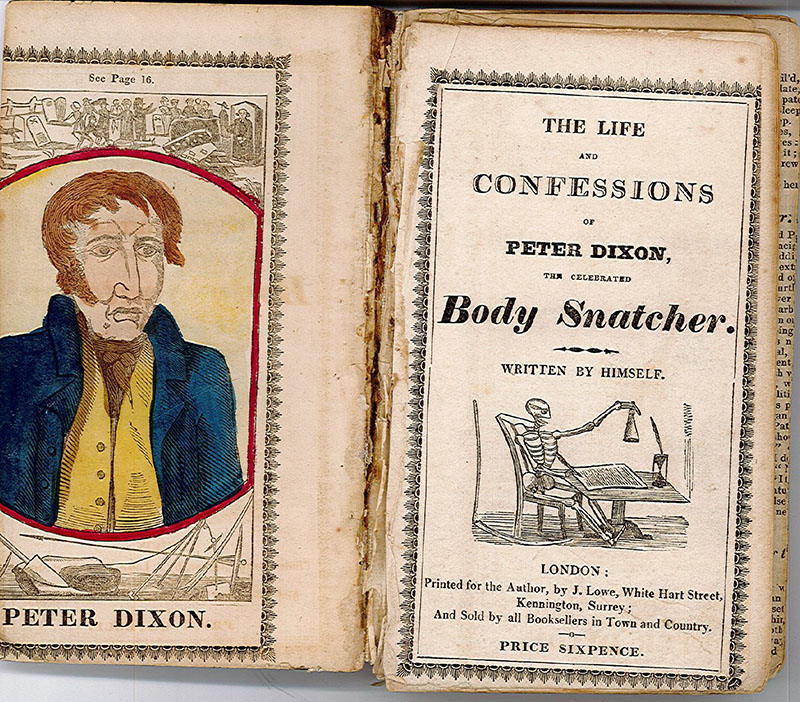
Dixon P. The life and confessions of Peter Dixon, the celebrated body snatcher. London: J. Lowe, [c.1827].
While these fictional scenarios exhibit more of the melodramatic fallacy than we’d expect in true case accounts (the misconception that conflicts, crises, and crimes in reality mirror the dramatic, highly sensationalised narratives seen in popular culture and media), the fictional accounts were almost certainly based on broadsheets, newspaper accounts, or ballads that were at least partly grounded in reality. These mirrored the public outcry created by real-life trials and executions of those involved in the “trade”.
Women as part of the network of resurrectionists
The 1828 Parliamentary Report from the Select Committee on Anatomy, established to investigate “the manner of obtaining subjects for dissection” and the law affecting those who obtained and dissected bodies, itself illustrates the difficulty of finding women in the trade. Eminent medical witnesses including Astley Cooper, John Abernethy, William Lawrence and Granville Sharp Pattison were identified by name, while some of those involved in procuring bodies gave evidence only under their initials.
In terms of historical visibility, there were only scant mentions of women in this report. Sources generated by courts, parliamentary investigations and newspapers naturally foreground those who were caught digging up, transporting, buying or murdering for bodies. Activities taking place within domestic and neighbourhood settings were more difficult to find and classify.
The term “resurrection man” may therefore describe the visible end of the trade rather better than the complete network that sustained it. Looking beyond the graveyard reveals women not simply as victims of the anatomical trade, but also as participants within it. Men may have been emphasised but taken together all the instances of women in the trade reveal it as one in which there were multiple players, and women could be present in many different roles, both as victims and, surprisingly, in support of and integral to both the body snatchers and the anatomists.
Sources
The principal historical sources used here are:
- The 1828 Report from the Select Committee on Anatomy, available from the Library collection.
- George MacGregor's The History of Burke and Hare and of the Resurrectionist Times, 1884, which brings together earlier newspapers, documents, ballads and traditions.
- The surviving 1832 broadside concerning Eliza Ross in the Borowitz True Crime Digital Collection.
- The life and confessions of Peter Dixon the celebrated body snatcher, (c.1827).
Corinne Hogan, Access & Engagement Manager